The Commercial Invoice: Your Essential Guide to Global Trade
More Than Just a Piece of Paper
In the world of international trade, a Commercial Invoice isn't just a request for payment. It's the backbone of your export documentation, the key that unlocks customs clearance, and a formal record of your transaction. For any business shipping goods across borders, getting this document right is non-negotiable. A well-structured Commercial Invoice ensures smooth logistics, prevents costly delays, and presents your business as organized and professional to partners and authorities alike.
Think of it as the central character in your shipping story. It communicates everything from the exact value and description of your goods to the agreed-upon terms of sale. Without a clear, accurate, and compliant invoice, your shipment can be held up, incur additional fees, or even be returned. It’s the document that freight forwarders, customs brokers, and government agencies rely on to do their jobs, making its clarity and completeness your direct responsibility.
Anatomy of an Effective Commercial Invoice Template
A powerful Commercial Invoice template is designed with clarity and compliance at its core. Visually, it should be clean, logically structured, and easy to navigate. The personality of the document is one of authority and precision—it’s a formal business record, not a marketing flyer. Its style is functional, prioritizing the accurate presentation of critical data over decorative flair. The overall appeal lies in its ability to be immediately understood by anyone in the global supply chain, from a warehouse manager in your country to a customs official overseas.
The best templates are fully editable, allowing you to tailor them to your specific needs while maintaining all required fields. This adaptability is key. A template that works for a small artisan exporter should also be robust enough for a larger logistics provider. It strikes a balance between a rigid, unchangeable form and a completely blank page, guiding you to include every necessary piece of information without stifling your business’s unique details.
Where This Template Truly Shines: Practical Applications
The utility of a solid Commercial Invoice extends across numerous business functions. For exporters, it’s the primary tool for declaring goods and their value. Freight forwarders use it to book cargo and prepare shipping manifests. Logistics providers depend on it to coordinate the physical movement of goods and handle customs brokerage. Even for a small e-commerce business starting to ship internationally, this document is your passport to entering global markets.
Its influence on your operations is significant. A clear and professional invoice enhances readability, ensuring there are no misunderstandings about what is being shipped. It establishes a strong visual hierarchy, with the most critical information—like totals, terms, and buyer/seller details—easy to find. This contributes to your brand perception, signaling that you are a serious, detail-oriented player. Consistency in using a standard template builds professionalism and aids in recognition with your regular partners. Ultimately, it fosters smoother audience engagement with the entire logistical chain, reducing queries and speeding up processes.
Integrating the Template into Your Workflow
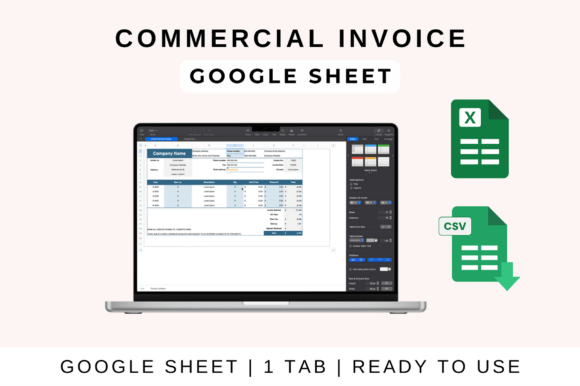
Getting started is straightforward, especially with modern tools. For teams using cloud-based collaboration, the template is fully compatible with Google Sheets. You simply upload it to Google Drive, open it, and begin entering your data. The structure is pre-built, so you’re guided through filling in buyer and seller information, itemized product descriptions with HS codes, quantities, unit prices, and calculated totals. You can easily customize categories and formulas to match your specific product lines or cost structures.
For those who prefer desktop software, the Excel and Numbers versions offer the same robust functionality. Download the file, enable editing, and you have a powerful tool at your fingertips. The key is to treat it as a living part of your export process. Once you’ve entered a transaction, you can save it as a record and use it as a base for the next shipment, ensuring all your design assets—in this case, your operational documents—are aligned and efficient.
Making It Work for Your Brand
While the Commercial Invoice is a functional document, it still plays a role in your overall brand identity. A clean, well-organized template reflects the same attention to detail you put into your products or services. It’s a touchpoint that demonstrates competence. Consider it part of your suite of business documents, alongside quotes, purchase orders, and packing slips. Using a consistent, professional format across all these touchpoints reinforces your reliability.
When evaluating or choosing a template, look for one that includes all the essential sections: detailed fields for the parties involved, a comprehensive item list, clear shipping terms (like Incoterms®), shipment method, payment details, and a required declaration statement. The goal is to find a template that acts as a trusted partner in your export transactions, helping you stay compliant and organized so you can focus on growing your business and reaching new markets with confidence.